Choosing a dining table involves more than finding a style you like. The shape of the table affects how it fits the room, how people move around it, and how many chairs can fit comfortably.
Rectangular tables are common, but they are not automatically right for every dining area. Round, square, and oval tables can also work well depending on the room and how your household uses it.
If you are comparing dining tables for your Salem Oregon home, start with the space itself rather than deciding on a shape first.
At a Glance
When comparing dining table shapes, consider:
- The size and shape of the dining area
- How many people regularly use the table
- How often you need additional seating
- Space for chairs and movement around the table
- Doorways and walking paths
- Table leg or pedestal placement
- Chair size
- Whether an extension table would be useful
There isn’t one table shape that works best in every home. Actual dimensions and how the table functions in the room matter more than shape alone.
Start With the Dining Area
Before deciding between a rectangular, round, square, or oval table, look at the room.
A longer dining area may naturally accommodate a rectangular or oval table. A more square dining area may work well with a round or square table.
These are guidelines, not rules. Doorways, windows, nearby furniture, and traffic patterns can change what works.
You also need to account for the chairs. A table may fit within the room’s dimensions but still feel crowded once chairs are pulled out and people are moving around them.
A commonly used planning guideline is to allow about 36 inches between the table and walls or other furniture where possible. Areas with regular foot traffic may benefit from more space.
Choosing Dining Room Furniture for Your Salem Oregon Home
Rectangular Dining Tables
Rectangular tables work naturally in many longer dining rooms and are available in a wide range of sizes.
They can be practical when you regularly seat several people because chairs can be positioned along both sides and, depending on the table design, at one or both ends.
Rectangular tables are also commonly available with extension leaves, allowing the table to stay smaller for everyday use and expand when additional seating is needed.
The main consideration is space. A long table can occupy a significant portion of the room once chairs and walking areas are included.
Don’t judge fit by the tabletop alone. Measure the complete dining area and consider where people will sit and walk.
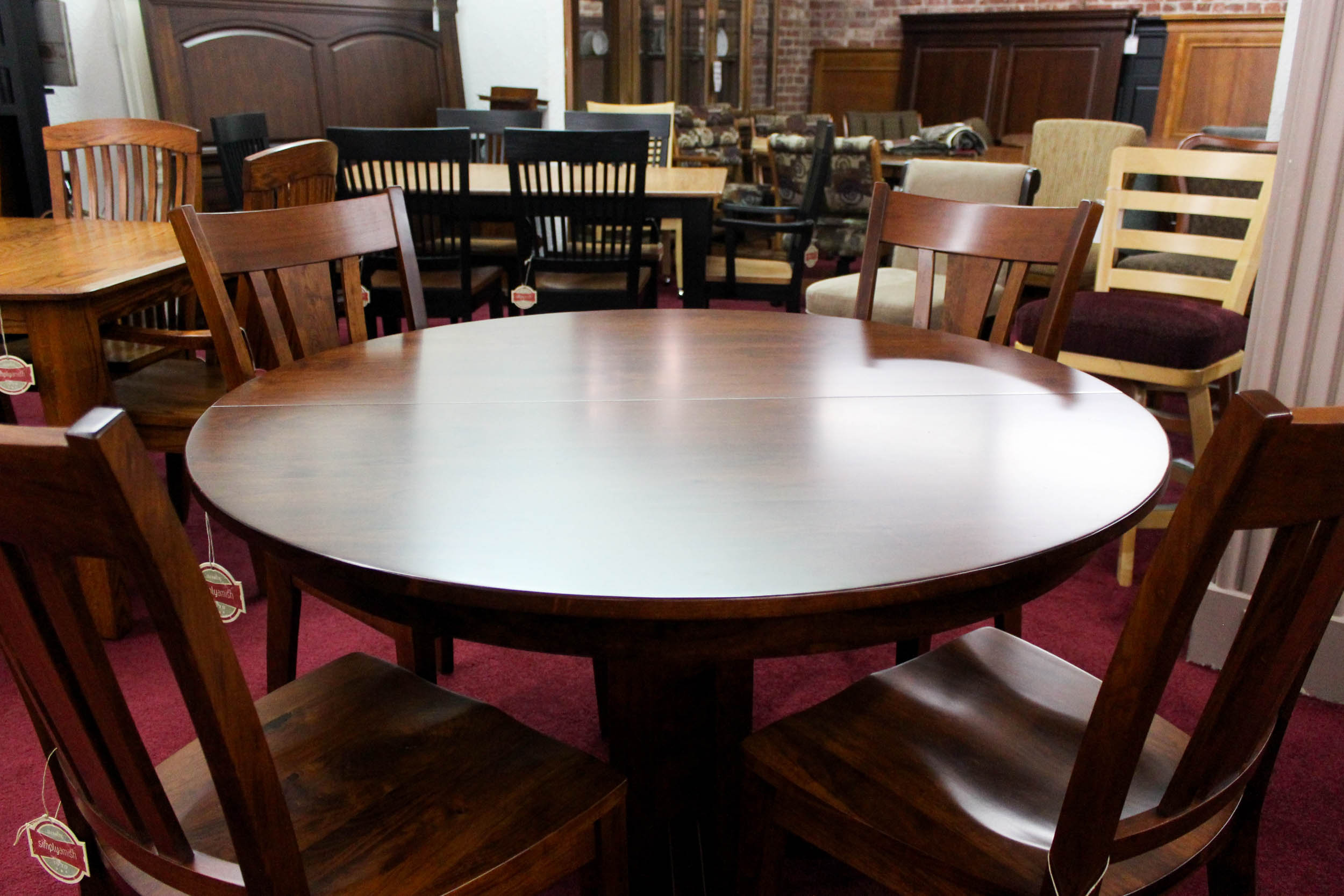
Round Dining Tables
Round tables can work particularly well in compact or roughly square dining areas.
Without corners, a round tabletop can also change how people move around the table, especially in a space with multiple walking paths.
However, a round table should not automatically be considered a space-saving option. As its diameter increases to accommodate more people, its overall footprint also increases.
Base design matters too. A pedestal base can provide more flexibility for chair placement than some leg configurations because there are fewer table legs competing for space underneath.
When comparing round tables, consider the diameter, base, chair width, and total room dimensions together.
Square Dining Tables
Square tables can fit naturally into dining areas with similar proportions.
Smaller square tables can be practical for households that usually seat a limited number of people, and their equal sides create a balanced arrangement.
Larger square tables require more room in both directions. As the tabletop gets wider, the distance to the center also increases.
If you like the proportions of a square table but occasionally need more seating, some designs offer extension options that convert to a longer configuration.
As with any table, check the extended dimensions before deciding whether it will work in your room.
Oval Dining Tables
Oval tables offer an elongated shape similar to a rectangular table but with curved ends.
They can work well in longer dining spaces and may be worth considering when you prefer a table without square corners.
The curved ends can also change how people move around the ends of the table, although an oval table is not automatically smaller or more space-efficient than a rectangular one.
Dimensions remain the deciding factor.
Compare the table’s overall length and width, available seating positions, base design, and the amount of room around it.
Table Shape Isn’t the Only Factor
Two tables with similar dimensions and the same general shape can function differently.
The base is one reason.
Four-leg, pedestal, and trestle designs create different amounts of usable space underneath the table. Leg placement can affect where chairs fit, particularly when you are trying to add seating near the ends or corners.
Other details worth checking include:
- Overall table dimensions
- Table height
- Leg or pedestal placement
- Apron depth
- Space between the legs
- Chair width
- Whether armchairs fit beneath the table
- Extended dimensions, if applicable
This is why it helps to consider the table and chairs as a complete dining set rather than choosing each piece based only on appearance.
Dining Room Furniture in Salem Oregon
Plan for Everyday Seating First
Think about how many people use your dining table most days.
If four people regularly sit at the table but eight visit only occasionally, you may not need a table sized for eight people all the time.
An extension table can provide flexibility in this situation. It can remain more compact for everyday use and expand when additional surface area and seating are needed.
If you regularly seat a larger household, a fixed table with enough permanent seating may make more sense.
The important point is to choose for the way the table will actually be used rather than automatically buying for the largest gathering you can imagine.
Remember the Chairs
A dining table doesn’t function by itself.
Chairs add to the space required around it, and chair dimensions can affect how many people can sit at a particular table.
A wider chair, an armchair, and a narrow armless chair will not occupy the same amount of space. Table legs and aprons can also affect where chairs can be positioned.
Before buying, check the dimensions of the chairs you plan to use with the table.
You should also consider what happens when someone is seated. There needs to be enough room to pull the chair away from the table and, where necessary, for someone else to pass behind it.
This is especially important when the dining area is located along a common pathway through the home.
Choosing Furniture that Fits Your Salem Oregon Home
Consider the Rest of the Room
Not every home has a separate dining room.
The table may be next to the kitchen, part of an open living and dining area, or positioned between frequently used parts of the home.
In those situations, look at how people naturally move through the space.
A table can technically fit within the available floor area while still making a walkway inconvenient once chairs are occupied.
Also consider other dining-room furniture. Buffets, cabinets, or other storage pieces require floor space and may need clearance for doors or drawers.
Looking at the entire room helps prevent choosing a table that works on paper but feels crowded in everyday use.
Extension Tables Can Add Flexibility
Extension tables are useful when everyday and occasional seating needs are different.
Depending on the design, an extension table may use removable, self-storing, drop-leaf, or other extension mechanisms.
Before choosing one, check both the closed and fully extended dimensions.
The extended table still needs enough room for chairs and movement around it. If leaves are removable, consider where they will be stored when they are not in use.
It is also helpful to understand how the extension mechanism operates before buying, particularly if you expect to use it regularly.
Seeing the Table and Chairs Together Can Help
Measurements can tell you whether a table should fit, but they don’t tell you everything about how it will feel to use.
Seeing a table in person allows you to look at its proportions, base placement, finish, and construction. You can also see how different chairs fit underneath it.
Sitting at the table can help you evaluate the relationship between the chair and table for yourself.
If you are comparing dining room furniture in Salem Oregon, seeing different table shapes and chair combinations together can make it easier to understand the differences before deciding.
Complete Guide to High-Quality Furniture in Salem Oregon
Frequently Asked Questions
What dining table shape works well in a rectangular room?
Rectangular and oval tables often fit naturally in longer rooms because their proportions can follow the shape of the space. However, actual dimensions, chair placement, doorways, and traffic flow should determine the final choice.
Are round dining tables better for small spaces?
They can work well in some smaller or more square dining areas, but round tables are not automatically more space-efficient. Diameter, base design, chair size, and available clearance all matter.
Is a round or rectangular table better for a family?
Neither is automatically better. Consider the number of people who regularly use the table, room dimensions, chair placement, and whether you need additional seating for guests.
Are oval tables more space-efficient than rectangular tables?
Not necessarily. Curved ends can affect how people move around a table, but the actual length, width, base design, and surrounding space determine how well it fits.
Should I buy an extendable dining table?
An extension table can be useful if your seating needs change. Before buying, make sure your dining area can accommodate the table, chairs, and walking space when the table is fully extended.
Do dining tables and chairs have to match?
No. Tables and chairs can coordinate without coming from the same collection. From a practical standpoint, make sure the chair dimensions work with the table height, apron, base, and available space between the legs.
Choosing the Right Dining Table for Your Salem Oregon Home
There is no single dining table shape that works best for every home.
Rectangular, round, square, and oval tables can all be practical choices. What matters is how the table’s actual dimensions, base, and chairs work with your dining area.
Start with the room, determine how many people regularly use the table, and consider traffic flow and occasional seating needs. If you are considering an extension table, measure for both its everyday and fully extended configurations.
Choosing based on how the dining area is actually used will give you a better starting point than choosing a table shape based on appearance alone.
